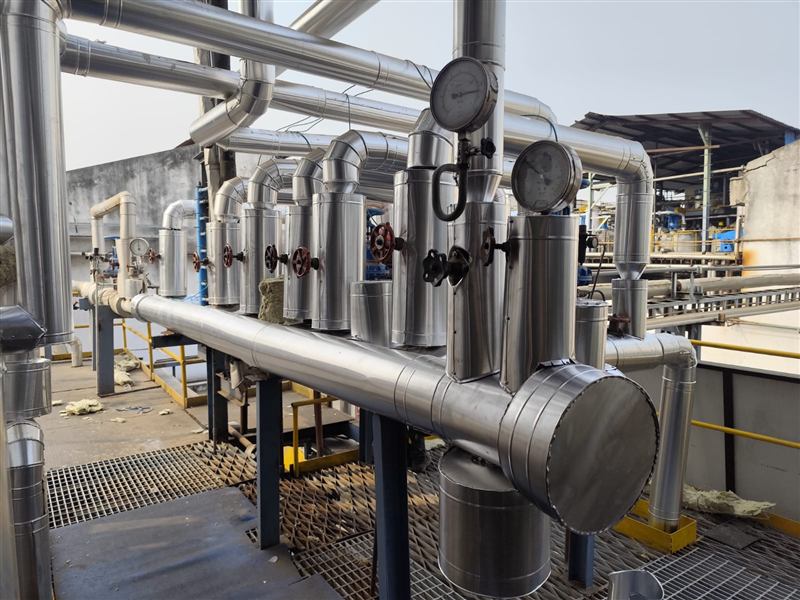
Industrial Insulation Guide: Hot vs Cold Insulation, Materials, Thickness and Cladding
A plain-language guide for plant engineers, purchase managers and contractors, from the team at Phoenix Insulations.
Trusted by
 Adani Wilmar
 Gopal Glass Works
 Gobind Glass & Industries
 N K Proteins
 Realcade Lifescience
 Moly Metal
- & many more plants across Gujarat
Why insulate at all?
- To save fuel and power. Bare hot pipes and tanks lose heat every hour they run, and bare cold lines make the chiller work harder.
- To protect people. Insulation brings hot surfaces down to a safe touch temperature.
- To keep the process steady. Liquids and gases stay at the temperature the process needs.
- To stop condensation. Cold lines stay dry, so there is no dripping and no rust.
Hot insulation vs cold insulation
| Hot insulation | Cold insulation | |
|---|---|---|
| Purpose | Keep heat in | Keep heat out and stop condensation |
| Typical lines | Steam, thermic fluid, hot water, flue gas | Chilled water, brine, refrigerant |
| Main materials | Rockwool LRB, pipe sections, slag wool | Nitrile rubber, PUF, thermocole |
| Biggest risk | Heat loss and burns | Moisture getting in |
| Key detail | Tight fit and weatherproof cladding | Sealed joints and a continuous vapour barrier |
| Finish | Aluminium or SS sheet cladding | Aluminium or SS sheet cladding |
Insulation materials at a glance
| Material | Used for | Typical temperature range | Good to know |
|---|---|---|---|
| Rockwool LRB mattress | Hot pipes, vessels, boilers, ducts | Up to about 650 to 750 °C | Non-combustible; wraps large and uneven surfaces |
| Rockwool pipe sections | Hot pipes | Similar to LRB, by grade | Fast, neat fit on straight runs |
| Slag wool | Hot lines and equipment | High temperature, by grade | Economical mineral wool |
| Nitrile rubber | Chilled water, HVAC, refrigerant lines | About -40 to +105 °C | Closed cell and flexible; joints must be glued |
| PUF | Cold lines, tanks, cold rooms | Roughly -150 to +110 °C | Very low heat flow; needs a vapour barrier and cladding |
| Thermocole (EPS) | Cold rooms and tanks | Up to about +80 °C | Light and economical |
Ranges are typical market values, for guidance. Always check the manufacturer's data sheet for the grade you buy.
How insulation thickness is decided
There is no single correct thickness. It is worked out from:
- the operating temperature of the line or equipment
- the pipe diameter or equipment size
- the surrounding temperature, humidity and wind
- the target: a safe surface temperature, a limit on heat loss, or no condensation
- the insulation material itself
As a rough illustration only, steam lines are often insulated with 40 to 75 mm of rockwool, and chilled water lines with 13 to 32 mm of nitrile rubber. Your own lines should be checked one by one.
Why cladding matters
Cladding is the metal sheet fitted over the insulation. It keeps water out and protects the insulation from damage. Aluminium sheet is used for most plant work. Stainless steel is used in pharmaceutical and food plants and in corrosive areas.
Joints should overlap, and the overlap should face so that rain runs off instead of into the joint.
Common mistakes we see on site
- Bare valves and flanges. One uninsulated valve can lose as much heat as a metre or more of bare pipe of the same size.
- Open joints on cold insulation, which let moist air in and start sweating and rust.
- Wet insulation left in place. Once wet, it stops insulating and corrodes the pipe underneath.
- Cladding overlaps facing the wrong way, so rain runs into the joint.
- Insulation crushed at pipe supports, which leaves thin spots.
Looking after insulation
Walk the lines once or twice a year. Look for dented or open cladding, missing screws, stains and damp patches, and frost or drips on cold lines.
Small repairs done early cost far less than replacing a corroded pipe.
Checklist before you ask for a quotation
- Line sizes and lengths, or drawings or a BOQ
- The operating temperature of each line
- Whether the lines are indoors or outdoors
- The material and cladding you prefer, if any
- The site location and your timeline
FAQ
Common questions
What is the difference between hot and cold insulation?
Hot insulation keeps heat in on steam lines, boilers and tanks, usually with rockwool and metal cladding. Cold insulation keeps heat out and stops condensation on chilled water, brine and refrigeration lines, usually with nitrile rubber or PUF and sealed joints.
Which insulation is best for steam lines?
Rockwool is the usual choice: pipe sections for smaller lines and LRB mattresses for larger lines and equipment, covered with aluminium sheet cladding.
How long does industrial insulation last?
With sound cladding and dry conditions it lasts for many years. Damage usually starts where water gets in, so cladding and sealing matter most.
Get a quote
Send us your insulation requirement
Share line sizes, lengths, temperatures or a BOQ. Fill in the form and it opens WhatsApp with your details ready to send.
- Mr. Kamlesh Panchal
- +91 98250 46241
- Chat on WhatsApp
- kamleshpanchal246@gmail.com
- 59/797, Prakashdip Appt., Opp. Bhavsar Hostel, Nava Vadaj, Ahmedabad, Gujarat, 380013